By the Bouwsector België team, 97 in-house tradespeople · reviewed by Geert Jan Hendrik, director · updated
Replacing a fuse box (consumer unit) in Belgium costs around €560 on average for a simple single-phase unit and €750 to €1,400 for one with 8 or more circuits or a three-phase supply, including installation. According to installers, a standard replacement is often finished within half a day.
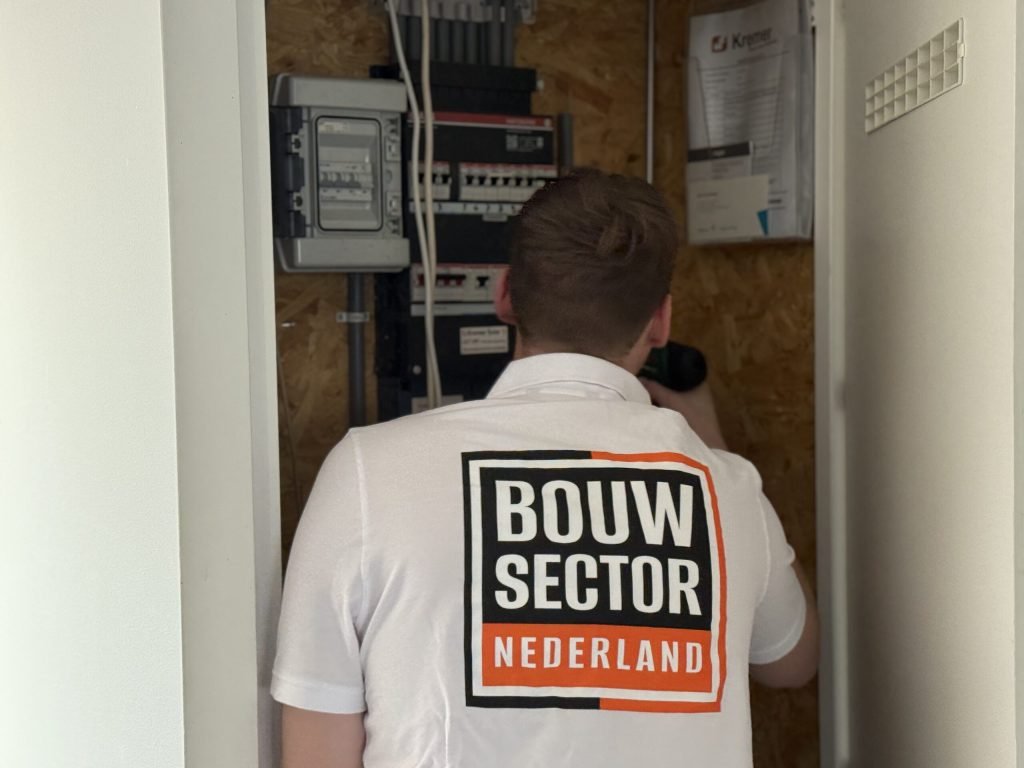
At Bouwsector België we include the electrics in the renovation of your home: our own electricians replace the fuse box, the meter cupboard and the wiring, and our plasterers then finish the walls neatly again. You will hear your exact price after a visit or in your quote, following the free consultation.
New electrics, with the walls neatly finished afterwards? Request your quote
After a free consultation you receive a plan and a quote for the electrics and the finishing, from one contractor with its own people
These are the going rates in Belgium in 2026, taken from public price overviews, including materials and installation.
Work
Going rate
Fuse box replacement, single-phase
on average €560, usually between €485 and €660
Fuse box with 6 to 10 circuits
on average €1,000 to €1,200
Three-phase fuse box
between €535 for 4 circuits and €1,400 for 12 or more circuits
Additional electrician’s work
on average €60 per hour
Rewiring a home during a renovation
between €35 and €50 per m² of floor area
Indication of going rates in Belgium in 2026, based on public price overviews; these are not consistent about VAT. For renovation work on a home over 10 years old, 6% VAT usually applies, otherwise 21%. You will hear your exact price after a visit or in your quote, following the free consultation.
Rewiring a 120 m² home therefore comes to €4,200 to €6,000. The fuse box is then only a small part of the job.
A three-phase installation also needs a heavier connection. You apply for it with your distribution network operator (in Flanders that is Fluvius), who charges separately for it. Ask about current rates and conditions beforehand, as they differ between operators.
These factors determine what it costs in your case:
the number of circuits and residual-current devices (RCDs);
single-phase or three-phase, for example for an induction hob, a heat pump or a charging point;
how much has to be done in the walls, and the finishing afterwards.
When should you replace your fuse box?
There is no fixed replacement deadline, but with an old unit it is sensible. Fuse boxes in older homes often have no residual-current device (RCD). It cuts the power when there is a leakage current, for example from a faulty appliance.
These signs point to a unit that is due for replacement:
there is no RCD or main switch;
there are too few circuits, so one trips regularly;
you are adding an induction hob, a heat pump or a charging point;
you are renovating the home and the wiring is as old as the unit.
The replacement itself usually takes less than a day, and with a standard unit you are often done within half a day. If the unit has to be moved or new cabling runs through the house, it takes longer and belongs in the renovation schedule.
What rules must a new electrical installation meet?
Electrical installations in homes must comply with the AREI, the General Regulations on Electrical Installations. A new or substantially renewed installation, and the sale of a home, require an inspection by an approved inspection body. Ask your installer how that works in your situation.
If you buy an older house, have the electrics looked at during the consultation. Whether the wiring can stay or must be replaced largely determines what a renovation costs.
The meter and the main connection belong to the network operator. Everything behind it, from the fuse box onwards, is part of the installation in your home.
What happens to the walls when the electrics are renewed?
New cables and boxes go into the wall. Chases are cut for them, and these then have to be filled and made flat again. That happens before the walls are plastered, wallpapered or painted, because whatever is covered later goes first.
If you have the electrics and the finishing done in one job, the price per m² comes down. Here is an example using our prices, where the walls are plastered ready for painting and then primed and painted. The measurements are an assumption.
Finishing after new electrics
20 m², separate
80 m², one job
Plastering walls ready for painting, €22.99 per m²
€459.80
€1,839.20
Priming and painting, €18.99 per m²
€379.80
€1,519.20
Small job surcharge, under 50 m²
€249.99
none
Call-out charge, one-off
€99.99
€99.99
Total
€1,189.58
€3,458.39
Per m²
€59.48
€43.23
Prices from our 2026/2027 price list, valid from 1 September 2026. Prices exclude VAT; for homes over 10 years old, usually 6% VAT.
Having only the patches around the new cables repaired therefore costs €16.25 more per m². In a renovation it is cheaper to include whole walls, which will also look even once painted. What the plaster coat costs per m² and why is explained under plastering cost per m².
Wouldn’t it be better to replace the fuse box on its own?
If it is only about the unit, that is perfectly fine. A standard replacement is usually done within a day, and little changes on the walls.
In a renovation it is different. The electrics, the walls and the finishing depend on each other. The electrician has to be finished before the plasterer starts, and a new socket after painting means a patch that has to be redone.
We take on the lot together, in one schedule: first the electrics, then the plastering, then wallpaper and paint. We start on the day we agree together.
How does it work when we renew your electrics?
Request. Request a quote or call us on working days between 9:00 and 17:00. Send a photo of your meter cupboard and tell us when your home was built.
Measuring up. If you agree, we measure up and check the walls. The final price and schedule are then fixed.
Works. First the electrics, then the finishing of the walls.
Our own electricians do the electrics, and four in-house contractor teams of four people each do the other structural work. In addition, our 97 in-house tradespeople do the finishing: 40 wallpaper hangers, 32 plasterers and 25 painters. We are also currently renovating 150 shops.
You pay nothing up front: 50% on the first working day, once all materials are on site and we have started, and 50% on completion. We work throughout Belgium: Flanders, Brussels and Wallonia.
Replacing a simple single-phase fuse box costs around €560 including installation. A unit with 8 or more circuits or a three-phase unit usually costs €750 to €1,400. You will hear your exact price after a visit or in your quote, following the free consultation.
What does switching to three-phase cost?
A three-phase fuse box costs between €535 for 4 circuits and €1,400 for 12 or more circuits from the installer. You apply for the heavier connection separately with your distribution network operator, in Flanders Fluvius. Ask about current rates beforehand.
How long does it take to replace a fuse box?
Replacing a standard unit usually takes less than a day, often only half a day. If the unit has to be moved or new cabling runs through the house, it takes longer and we plan it into the renovation, before the plastering.
Is a new fuse box compulsory?
Not always, but it is sensible if there is no RCD in the unit. Older units often lack one. A new installation must comply with the AREI.
What does finishing the walls after new electrics cost?
With us, plastering ready for painting costs €22.99 per m² and priming and painting €18.99 per m², excluding VAT. Separate patches totalling 20 m² cost €59.48 per m² including the surcharge and call-out charge, while whole walls of 80 m² in one job cost €43.23 per m².
 By the Bouwsector België team, 97 in-house tradespeople · reviewed by