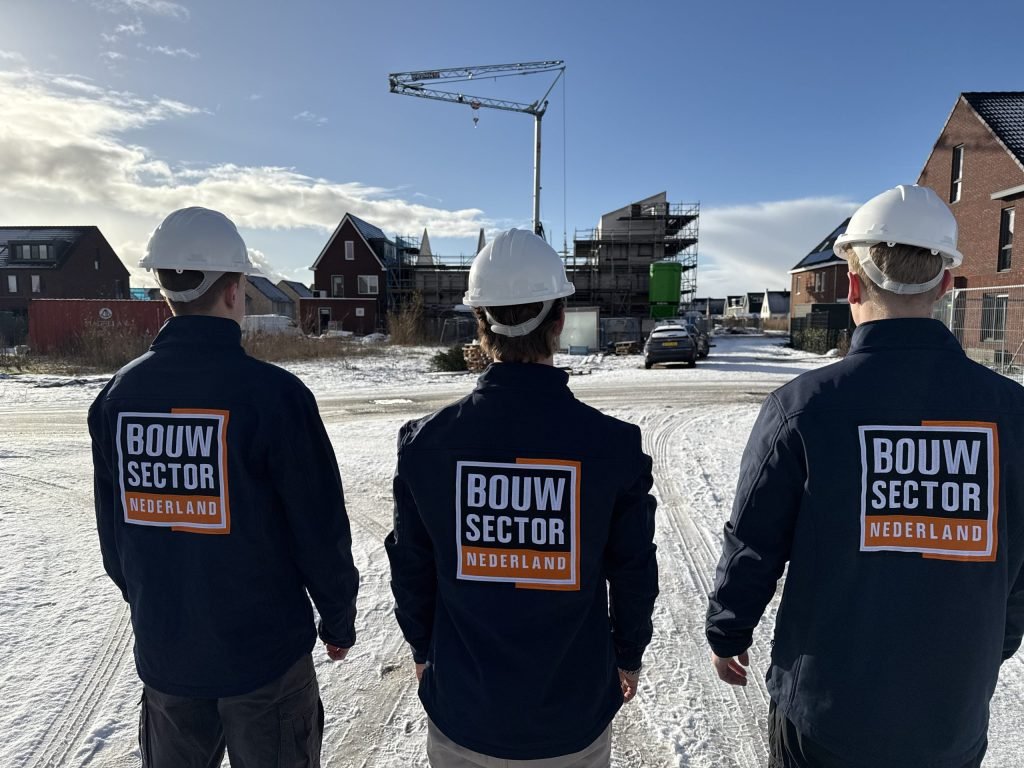
By the Bouwsector België team, 97 in-house tradespeople · reviewed by Geert Jan Hendrik, director · updated
Renovating a 1970s house costs, going by typical 2026 market prices, an average of €80,000 to €150,000 for a complete terraced home. Finishing only the walls and ceilings costs €14,472.23 to €17,331.13 in our worked example. With those walls and ceilings, it is all about texture: spachtelputz, granol, timber panelling and old wallpaper.
Do you have a house built between 1965 and 1974 in mind? Send us the address and the floor area, and you will receive a price indication within 24 hours, before you even make an offer. As your contractor, we then take the whole process off your hands, from the first price to the final handover.
At Bouwsector België, our four in-house building teams do the structural work, and our own plasterers, wallpaper hangers and painters finish the house. Removing old plasterwork costs €14.99 or €22.99 per m², and plastering ready for painting costs €22.99 per m², excluding VAT.
Decorative plasters were popular in the 1970s: spachtelputz, granol and rustic plaster, in various coarse grains. Ceilings were often clad in timber panelling. Much of that finish is still there, sometimes under a few layers of paint or wallpaper.
Beyond the finish, this building period has its own typical points of attention: a cavity wall with little or no insulation, old electrics that may no longer meet the AREI rules and, in some homes from that period, floors where concrete rot can occur. One of our building teams covers these points in the advisory meeting.
What you find
What it needs
Our price
Spachtelputz or other decorative plaster on the wall
Skim smooth if the layer is firmly attached, otherwise remove it first
Removal € 14.99 (thin) or € 22.99 (thick) per m², then plastering € 22.99 per m²
Granol or another grain on the ceiling
Remove it or skim smooth
Removal as above, then plastering the ceiling at € 23.99 per m²
Timber panel ceiling
Keep it, or replace it with a new ceiling
Replacement: bespoke, priced exactly after the advisory meeting
Old wallpaper
Remove it
From € 6.99 per m²
Wooden doors and window frames
Sanding and painting
Door and frame from € 249.99 per set
Prices from our 2026/2027 price list, valid from 1 September 2026. Prices exclude VAT; renovation work on a home over 10 years old usually carries 6% VAT.
Skimming smooth has no fixed per-m² price with us, because the grain, the adhesion and old paint layers differ from wall to wall. Removing and re-plastering does. Whether a layer can stay is decided during the on-site survey with a tap test. That is also how it works if you have spachtelputz plastered smooth.
What do you do with spachtelputz and a timber panel ceiling?
Spachtelputz and decorative plaster. Paint and wallpaper do not remove the grain. Paint follows the texture exactly, and a coarse grain shows through wallpaper. If you want smooth walls, a new layer of plaster is the only route: over the existing layer if it is firmly attached, or after removal if it is coming loose.
On the ceiling, grain is more noticeable, because light falls across it at a low angle. According to the Knauf MP 75 technical data sheet, a layer on a ceiling of masonry material goes on in one pass, up to a maximum of 15 mm. With a coarse granol grain, removing decorative plaster or granol is therefore often the calmer choice.
Timber panel ceiling. If you want to keep the wood, the ceiling simply stays. If you want a smooth, white ceiling, the panels usually come off and a new ceiling goes in. Our building teams do that structural part, after which our plasterers finish the ceiling ready for painting at €23.99 per m².
What is behind the panels and what they are fixed to only becomes clear once they are off. That is why we put that item in the quote after the advisory meeting, rather than as a fixed per-m² price.
Asbestos. Asbestos may have been used in older homes, and a 1970s house certainly falls into that category. You cannot recognise asbestos with the naked eye. Before a renovation, an asbestos survey is sometimes advisable, so mention the year of construction in the advisory meeting.
What does it cost to renovate a 1970s house?
For a complete renovation of a 1970s terraced house, these typical market prices apply in 2026. They are indications; the exact price for your home follows after the advisory meeting and the quote.
Item
Market indication
Insulation of roof, floor and façade
€ 15,000 to € 35,000
Replacing windows and doors
€ 10,000 to € 25,000
Electrics and plumbing
€ 10,000 to € 20,000
Kitchen and bathroom
€ 10,000 to € 30,000
Asbestos removal, if present
€ 2,000 to € 15,000
Complete renovation, average
€ 80,000 to € 150,000
Market indications: typical prices in Belgium in 2026. For a home over 10 years old, renovation usually carries 6% VAT, otherwise 21%.
For the finishing of walls and ceilings, we use our own fixed prices. A worked example: a 1970s house with 220 m² of wall. On 110 m² there is loose spachtelputz, on the other 110 m² a single layer of paper wallpaper. The 75 m² ceiling has a granol grain that has to go. The dimensions are an assumption, not an average.
Item
Quantity
Rate
Amount
Removing spachtelputz, thick
110 m²
€ 22.99 per m²
€ 2,528.90
Removing paper wallpaper, 1 layer
110 m²
€ 6.99 per m²
€ 768.90
Removing granol from the ceiling, thin
75 m²
€ 14.99 per m²
€ 1,124.25
Plastering walls ready for painting, materials included
220 m²
€ 22.99 per m²
€ 5,057.80
Plastering ceilings ready for painting, materials included
75 m²
€ 23.99 per m²
€ 1,799.25
Priming and painting walls, 1 coat RAL 9010 or 9016
220 m²
€ 18.99 per m²
€ 4,177.80
Priming and painting ceilings, 1 coat RAL 9010 or 9016
75 m²
€ 19.99 per m²
€ 1,499.25
Floor protection runner, 60 to 120 m² of floor
one-off
€ 274.99
€ 274.99
Call-out charge
one-off
€ 99.99
€ 99.99
Total finishing
€ 17,331.13
Prices from our 2026/2027 price list, valid from 1 September 2026. Prices exclude VAT; renovation work on a home over 10 years old usually carries 6% VAT.
If the 110 m² of wall turns out to be flat enough under the wallpaper, renovation fleece can go on instead of plastering and painting. That costs 110 × €15.99 = €1,758.90, against €4,617.80 for plastering plus priming and painting. The house then comes to €14,472.23.
The biggest item is removing the loose spachtelputz. If that layer is firmly attached everywhere, it can be skimmed smooth and the €2,528.90 item falls away. You then receive the price for skimming after the on-site survey.
Does a 1970s house have to be stripped back completely first?
Not necessarily. The image of a 1970s house that has to be taken back to bare brick is only true if everything really is being replaced. For walls and ceilings, the rule is: only what is loose or what you want rid of comes off.
Spachtelputz that is firmly attached everywhere can stay and be skimmed smooth. That saves the removal item, and it saves dust and rubble in the house. The same goes for old plaster under the wallpaper: if it is firmly attached, it is a good base.
If the floors, the kitchen and the tiling also come out, it becomes a full house strip-out. That calls for its own assessment, such as the disposal of a lot of waste or the presence of asbestos. We cover this in the advisory meeting.
Got your eye on a house? Know the renovation cost before you offer
Anyone buying a 1970s house usually buys a renovation project too. If you know what it costs before you make an offer, you can factor that into your offer and your financing. Here is how it works:
Send us the property. The address, the floor area and what you want done. Photos from the estate agent’s listing help.
A price indication within 24 hours. Based on our fixed prices per m², with every item listed separately.
After the purchase, the survey. If you agree, we measure up and check the walls. The final price and the schedule are then fixed.
Between getting the keys and moving in. We start on the day we agree together, so the work is finished when you move in.
Many buyers include the cost in their home loan. Our quote lists every item separately, so you can hand it to your credit broker. We do not give advice on your financing ourselves; your broker does that. That is why we work with credit brokers. If you are buying in Flanders, also keep in mind the renovation obligation: you have to renovate the home to improve its energy performance within 5 years of purchase.
What do you gain from us doing everything from A to Z?
Doing up a 1970s house quickly means five tradespeople: someone for the electrics, a wallpaper stripper, a plasterer, a wallpaper hanger and a painter. If you arrange them yourself, you are the contractor. With us that is not necessary, because we are the contractor and take the whole process off your hands.
What you get
What that means for you
One point of contact
You call one number for everything. We coordinate the trades, and you do not have to chase anyone.
Our own tradespeople
97 of our own wallpaper hangers, plasterers and painters on permanent contracts, plus four in-house building teams for electrics, walls, floors, kitchen and bathroom. You know who is coming.
A schedule that holds
You know in advance when each trade comes, and we start on the day we agree together. Because every trade is ours, nobody waits for another party.
One party responsible
If something goes wrong between two trades, nobody points at someone else. We are responsible for the whole result.
Transparent costs
All our prices are public on our price list, and every item is listed separately in the quote. You pay nothing upfront: 50% on the first working day and 50% on handover.
No-obligation advisory meeting
Our contractor discusses your plans with you, at your home, on site or by phone. That way you know what needs to happen before you decide anything.
Prefer to talk it over first? Put your question directly to our contractor via our contact form or give us a call.
Our customers give us a 4.9 from more than 215 Google reviews, and we complete more than 600 homes every year. The texts on this site are checked by director Geert Jan Hendrik, who has worked in construction for 20 years.
How do you renovate a 1970s house with us?
Request a quote or call us on working days between 9:00 and 17:00. In a free advisory meeting we go through what needs to be done, from the textured walls to the floor and the kitchen. You then receive a plan and a quote.
If you agree, we measure up and tap-test the walls and ceilings. The final price and the schedule are then fixed, and we start on the day we agree together.
A plasterer plasters an average of 100 m² per day. The new layer then has to dry: gypsum plaster takes roughly four weeks under good conditions, according to Knauf. That drying time is built into our schedule before the painters or wallpaper hangers carry on.
The structural work is done by our four in-house building teams of four people each, and the finishing by our 97 in-house tradespeople. You pay 50% on the first working day, once all materials are on site and we have started, and 50% on handover.
That way you can have your whole home renovated by a single contractor, or have just the walls and ceilings plastered at the same fixed prices.
A complete renovation of a 1970s terraced house costs, going by typical 2026 market prices, an average of €80,000 to €150,000; the exact price follows after the advisory meeting. The finishing of the walls and ceilings is fixed with us: for 220 m² of wall and 75 m² of ceiling it comes to €14,472.23 to €17,331.13 in our example, excluding VAT.
Can you have spachtelputz plastered smooth?
Yes. If the layer is firmly attached everywhere, it can be filled and skimmed smooth; you receive that price after the on-site survey. If it is loose, it has to come off first, at €14.99 or €22.99 per m², and we then plaster the wall ready for painting at €22.99 per m², excluding VAT.
What do you do with a timber panel ceiling?
If you want to keep the wood, it stays. If you want a smooth, white ceiling, the panels usually come off and a new ceiling goes in. Our building teams do that; our plasterers then finish the ceiling ready for painting at €23.99 per m², excluding VAT.
Is there asbestos in a 1970s house?
There can be. Asbestos may have been used in older homes, and you cannot recognise it with the naked eye. Before a renovation, an asbestos survey is sometimes advisable, so mention the year of construction in the advisory meeting.
How long does it take to finish a 1970s house?
A plasterer plasters an average of 100 m² per day. Gypsum plaster then needs roughly four weeks to dry under good conditions, according to Knauf, before paint can go on. If flat walls get renovation fleece, filling, sealing and painting a complete house takes 3 days.
Can I get a price before I make an offer?
Yes. Send us the address and the floor area, and you will receive a price indication within 24 hours based on our fixed prices per m². If you want to talk first, our contractor will discuss your plans in a no-obligation advisory meeting, at your home, on site or by phone.
 By the Bouwsector België team, 97 in-house tradespeople · reviewed by