By the Bouwsector België team, 97 in-house tradespeople · reviewed by Geert Jan Hendrik, director · updated
Streaks on a freshly painted wall almost never come from the paint itself, but from the way it was applied or from the surface underneath. Sigma’s application guidelines point to four causes: thinning too much, working outside the prescribed temperature and humidity, a surface that absorbs unevenly, and a wall that was not yet dry.
Then there is the classic that no data sheet mentions but every painter knows: letting the wet edge dry before the next strip goes on.
A wall with an even finish in one go? Request your quote
Rating 4.9 out of 5. ★★★★★4.9 from 215+ Google reviews · 97 in-house tradespeople on permanent contracts · 10 years of experience · 1-year guarantee on interior painting
Which kind of streak do you see, and what does it tell you?
Before you repair anything, it pays to look at what kind of streaks they are. They look different and they have different causes.
What you see
Likely cause
Straight, vertical strips with visible edges
The wet edge dried before the next strip went on
Cloudy, uneven patches across the whole wall
The wall absorbs unevenly, or the paint was thinned too much
Dark or light patches in clearly defined spots
Repair spots, filler or old stains that absorb differently
Patchy, uneven colour on new plaster
Lime bleed-through from a surface that had not yet fully set
Shiny smears at eye level, appearing later
Touching or cleaning matt wall paint within reach
Streaks only along skirting board, frame and ceiling
The edges were cut in with the brush and not rolled over again
Only judge the wall once it is completely dry, and let daylight fall across it at an angle. A coat that is still wet always looks uneven; that tells you nothing.
How much may you thin wall paint?
Less than most DIYers think. Technical data sheet 4014NL for Sigmatex Superlatex Matt, Sigma’s wall paint, sets firm limits per tool.
Method of application
Thinning with tap water
Roller and brush
0 to 7 per cent by volume
Airless spraying
0 to 10 per cent by volume
Seven per cent by volume on a 10-litre tin is therefore at most 0.7 litres of water, and zero is fine too. Anyone who pours half a tin of water in because the paint “rolls on too stiffly” thins the coat so far that the coverage underneath suffers. The result is a wall that turns cloudy and lets the surface show through.
Thinning is also rarely the solution to the problem it is used for. If the paint rolls on stiffly, the wall is usually too absorbent or too cold, not the paint too thick. You can recognise that with the tests below, and then priming walls is often the real solution.
Why must you keep a wet edge?
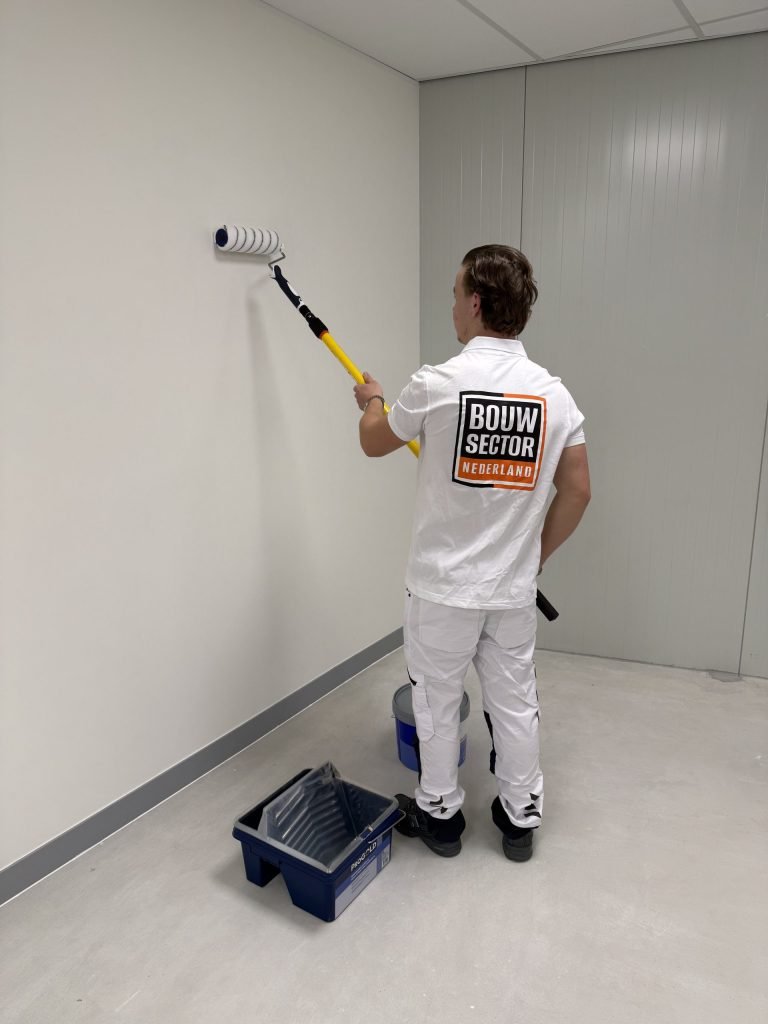
Wall paint only bonds invisibly to a strip that is still wet. If you roll one strip, go to fetch a coffee and then put the next strip against it, you will later see exactly where the first one had already dried. That is a lap mark, and on a large wall in raking light it cannot be polished away.
The rule is therefore: finish a whole wall in one go, from top to bottom and from one corner to the other, and never stop halfway along a wall. Stop at a corner, a window or a door.
Sigma gives no separate rule for the wet edge, but it does give the conditions that determine how quickly it closes up. For proper drying, the surface and surroundings must be between 5 °C and 30 °C, the relative humidity must stay below 85%, the wall must be at least 3 °C above the dew point and there must be good ventilation.
In a warm room in full sun the edge dries much faster than at 15 °C, so you have less time per strip.
The drying times give the margin: for Sigmatex Superlatex Matt, Sigma states touch dry after about 2 hours and ready for overpainting after about 4 hours, at 23 °C and 50% relative humidity. That margin also determines how long wall paint needs to dry before a second coat.
Would you rather not wrestle with the wet edge yourself on a large wall?
More often than you think. A wall that takes up more paint in one spot than in another shows a difference in colour after drying, however neatly it was rolled.
For Sigmatex Superlatex Matt, Sigma specifies that absorbent and unevenly absorbent surfaces must first be sealed with Sigmafix Universal, diluted 1 to 4. That is not an optional extra but a requirement of the system. The paint system for absorbent mineral surfaces states: fix with Sigmafix Universal, then finish with two coats of wall paint.
The surface must also be dry. The data sheet requires a fully set, sound and dry surface, with a maximum of 4% moisture and a maximum of 1% for gypsum-based surfaces. If painting is done too early, Sigma says colour mottling can occur through lime bleed-through, and in the worst case the product can be damaged.
Situation
What has to happen first
New plaster
Let it dry completely, then prime
Plasterboard or bare wall that absorbs
Seal with a stabilising primer
Filler and repair spots
Prime, because they absorb differently from the rest
Old paint that turns chalky when touched
Remove the dust and prime so the layer is bonded
Wall with grit or old paint drips
Sand, otherwise you will see every imperfection in the new coat
You can test yourself whether your wall absorbs or chalks; then you know straight away whether you need to prime first. With fresh plaster the order is fixed: let it dry completely, then prime after plastering, and only then paint. If you wonder how long plaster needs to dry, we look at that during the site survey.
Does an extra coat of paint remove the streaks?
Sometimes, but far from always, and that is the biggest misunderstanding around this problem. If the streaks come from lap marks or from a first coat that was too thin, a second coat does indeed resolve them. There is then a sealed surface and the new coat does come out even.
If they come from uneven absorption or from lime bleed-through, an extra coat is money wasted. The cause lies under the paint, so it simply soaks in unevenly again. A primer has to go on first, and only then the paint.
If there are imperfections in the wall itself, such as joints, holes or bumps, no number of coats will make it flat. Under a fresh, even coat they sometimes stand out even more in raking light. In that case you first need to level the walls before painting.
How do we prevent streaks when we paint your walls?
The wall painting is done by one of our 25 painters, from a team of 97 in-house tradespeople on permanent contracts that also includes 40 wallpaper hangers and 32 plasterers. We therefore schedule plastering and painting ourselves, one after the other, with the drying time in between.
State in your request whether the wall has been newly plastered, whether it has repair spots and whether there are already streaks on it. The free quote you receive within 24 hours then already allows for a primer where that seems necessary.
At the site survey we assess whether your wall absorbs, chalks or is still giving off moisture. On the working day we work through one wall at a time in a single go so that no lap marks appear, and we roll over the edges that were cut in with the brush.
Painting walls costs €12.99 per m² for one coat in RAL 9010 or 9016, paint included. Priming and painting together costs €18.99 per m², and a second coat €7.99 per m².
Prices exclude VAT. For renovation work on a home over 10 years old, 6% VAT usually applies, otherwise 21%. The VAT rate is shown in the quote.
Interior painting carries a 1-year guarantee, and at handover we walk through the walls with you. If you would rather leave it to us, we paint your walls. If you are torn between latex or emulsion paint: we work with the Sigma wall paint that keeps coming up above. The prices page lists the other rates.
FAQ
Frequently asked questions
Do streaks on a wall disappear by themselves as the paint dries?
A coat that is still wet always looks uneven, and that fades as it dries. If you can still see the streaks when the wall is completely dry and daylight falls across it at an angle, they will not go away by themselves.
How do you paint a wall without streaks?
Finish a whole wall in one go without stopping halfway, so the wet edge never dries. Thin the paint with no more than 7 per cent by volume of water for roller and brush work, as the data sheet for Sigmatex Superlatex Matt states, and make sure the wall is primed first if it absorbs.
Why do I see streaks along the ceiling and skirting boards?
That is where the edges are usually cut in with a brush. Brushwork has a different texture from roller work, and if those edges are not rolled over again, that strip stays visible. So roll as close to the edge as you can.
Can you simply paint over a streaky wall?
Only if the cause was in the paint layer, such as lap marks or a first coat that was too thin. If the streaks appear because the wall absorbs unevenly, a new coat will soak in unevenly again. A primer has to go on first.
What is lime bleed-through and how do you recognise it?
Lime bleed-through occurs when you paint on a surface that has not yet fully set. In the data sheet for Sigmatex Superlatex Matt, Sigma says this can lead to colour mottling. You see it as a patchy, uneven colour across new plaster, not as sharp strips.
 By the Bouwsector België team, 97 in-house tradespeople · reviewed by