A plasterer applies plaster layers to walls and ceilings so they are flat and ready for paint or wallpaper. Our 32 in-house plasterers plaster walls and ceilings ready for painting, apply skim coats, smooth over spachtelputz (textured render), remove old layers and also work outdoors, on request. We do not do decorative plasterwork, such as Venetian plaster or applying new ornamental render.
Your own plasterer for your walls? Request your quote
Not a subcontractor, but one of our 32 permanently employed plasterers, with the price and schedule set out in the quote up front
Rated 4.9 out of 5. ★★★★★ 4.9 from 215+ Google reviews · 97 in-house tradespeople on permanent contracts · 10 years of experience
What exactly does a plasterer do?
The Algemeen Nederlands Woordenboek, a Dutch-language dictionary, describes a plasterer (in Dutch: plafonneerder or stukadoor) as someone whose trade is applying plasterwork to walls and ceilings. In practice, spreading the layer is only part of the job. Everything that comes before and after is at least as important.
- Assessing the substrate. Is the old layer firmly attached, how flat is the wall and how absorbent is it?
- Preparation. Covering the floor, removing loose parts, fitting corner beads and pre-treating the substrate.
- Applying and levelling. Putting the plaster on the wall and pulling it flat with a long straightedge.
- Smooth finishing. Making the layer smooth until it is ready for paint, or flat enough for wallpaper.
- Drying. Only once the layer is dry can a primer and paint or wallpaper go on.
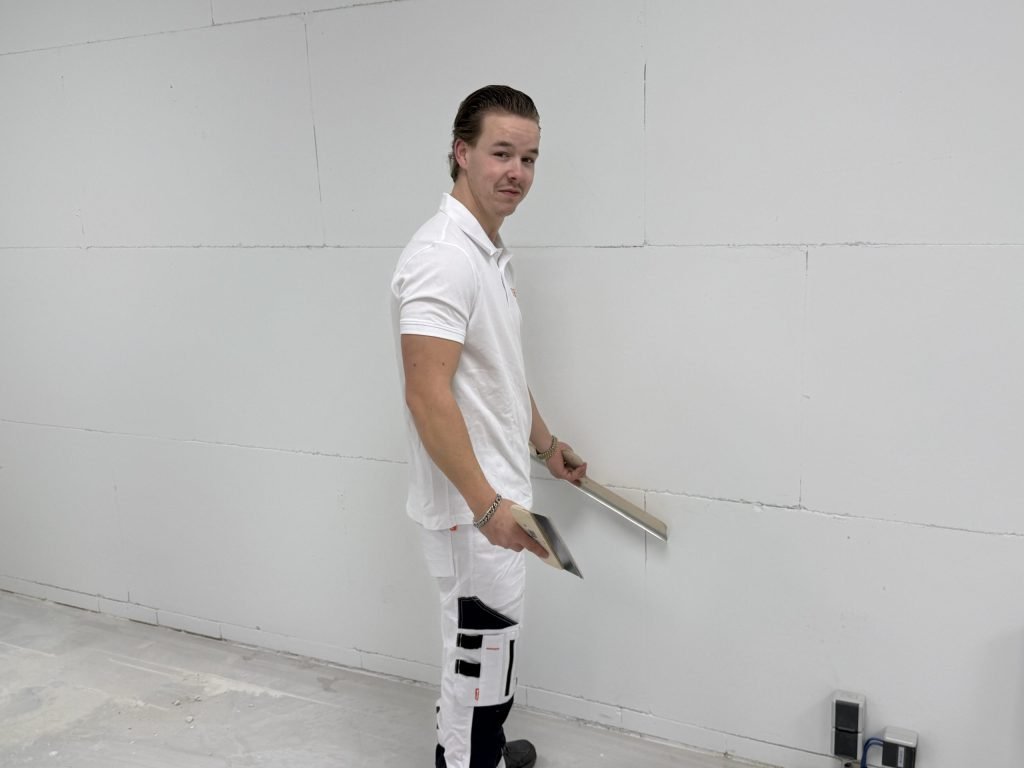
You can see how heavily this preparation weighs in manufacturers’ requirements. In the technical data sheet for MP 75 gypsum plaster, Knauf requires a dry, clean and stable substrate. Concrete must be at least 3 months old and contain no more than 3% residual moisture, and the temperature must be between +5 °C and +30 °C, for at least 48 hours after application.
What do our plasterers do?
Our plasterers do all the usual plasterwork, indoors and outdoors. Below you can see what each job involves and what it costs.
Prices exclude VAT. For the renovation of a private home more than 10 years old, 6% VAT usually applies; otherwise it is 21%. Plastering prices per m² always include materials.
So with us you can have a ceiling made smooth, have a skim coat applied under renovation fleece, have a textured wall made smooth or have old layers removed. Plasterwork in the bathroom and work on facades and exterior walls are also covered, the latter on request. On top of the m² price, extras such as corner beads can be added; you add those to the cost of plasterwork per m².
What does a plasterer not do with us?
What you cannot expect from our plasterers is just as important. That way you know where you stand in advance.
- Decorative plasterwork. We do not apply Venetian plaster, concrete-look finishes or new ornamental render. We do the opposite: we smooth existing texture.
- Painting and wallpapering. Our 25 painters and 40 wallpaperers do that. They are part of the same team, so we schedule them as soon as the plaster layer is ready.
- Plastering over a damp wall. A plaster layer only hides a damp problem. The cause has to be dealt with first and the wall must be dry.
- Assessing a growing crack. A crack that keeps growing or points to a structural problem should first be assessed by the contractor or a structural engineer.
If you are unsure whether something falls within our plasterers’ work, mention it during the phone call. Then you will know straight away.
Isn’t a plasterer just someone who smears plaster on a wall?
No. The layer itself is the visible part. Whether it stays in place and stays smooth depends mainly on the substrate and the pre-treatment.
According to Knauf, a strongly absorbent wall must be pre-treated first, and so must a smooth wall that barely absorbs. Gypsum plaster does not bond to a painted wall on its own. An old layer that is loose will take the new layer with it later. A plasterer who fails to spot that beforehand delivers a wall that looks good for the first few weeks.
Then comes the scheduling. According to Knauf, gypsum plaster can be sufficiently dry after about four weeks under good conditions. Anyone who paints too early gets stains or peeling paint. And even when it is dry, a primer goes on first to get new plaster ready for painting.
With new builds, a good plasterer looks even further ahead. A new home settles and shrinks in the first few years, and a hard plaster layer cracks along with it. That is why we usually recommend a skim coat with renovation fleece instead of a thick layer. When choosing between plaster and renovation fleece, that shrinkage weighs heavily.

How does a plasterer from Bouwsector België work?
Our plasterers are permanently employed, not hired-in subcontractors. They are part of a team of 97 tradespeople, and the same crew works on your job from start to finish. We have been doing this work for 10 years and finish more than 600 new-build homes every year.
When you apply, tell us what is on the wall now, such as paint, wallpaper, spachtelputz or tiles, and whether it is a new build or an existing home. Then the right item is already in the free quote you receive within 24 hours.
During the site visit we assess the substrate, take measurements and decide what each wall needs, so that a loose old layer is not discovered only after plastering.
On the working day, the plasterer covers the floor, fits the corner beads and applies the layer. A plasterer does an average of 100 m² per day. Once it has dried, we schedule the painting or wallpapering with our own painters and wallpaperers.
If you want to hire a tradesperson for your walls, it follows the same steps: request, quote, site visit and working day. That applies to all walls and ceilings you have finished with us.
 By the Bouwsector België team, 97 in-house tradespeople · reviewed by